
Hooks
The use of hooks dates back to prehistoric times. The very first hooks were not durable; our ancestors made them from bone and wood. The ancestor of the fish hook was the gorge. Then, among Egyptian artifacts, pieces made of brass were found, and later, in Roman times, brass was replaced by iron and bronze, and hook-making blacksmiths appeared. The company for modern hook manufacturing was founded in Norway in 1832. After this, hook making and its surface treatment underwent rapid development. High-quality materials are used today in the manufacture of hooks. In the TACKLEBAIT offer, numerous hook types and variations can be found that are applicable to all fishing methods.
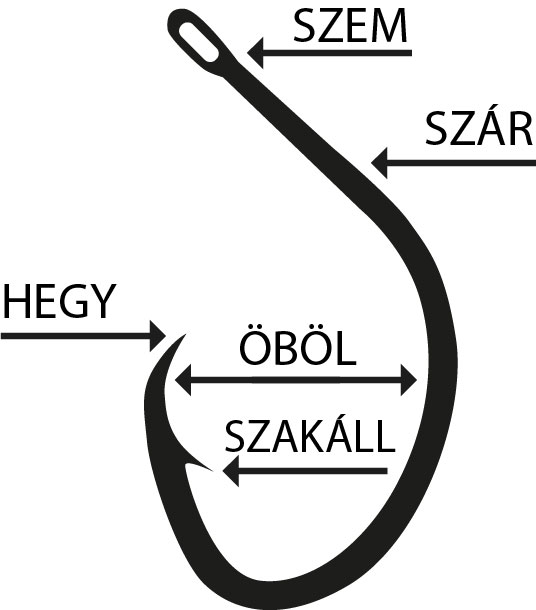 |
Different types of hooks are needed for different fishing methods. Their shape can vary, for example: the barb can be inside or outside the hook, or the shank can be eyed or spaded. But in their structure, all hooks are the same. Characteristic parts of a hook: Eye: To this, we attach the line. Shank: The part extending downwards from the eye to the bend. Point: Sharp, strong part, into which the fish's mouth penetrates. Gap: The distance between the hook's shank and point. Barb: A backward-curving spike, preventing the hook from coming loose. |
Besides Feeder and fine-tackle hooks developed for coarse fish, and Carp and Boilie hooks, we also offer numerous high-quality Predator hooks for predatory fish fishing. Spinning-offset hooks for lures are also available in a wide selection in our range. Naturally, indispensable double and treble hooks for live bait fishing are also not missing from our palette. A wide selection of pre-tied hooks also awaits those who prefer this convenient and practical solution!

What hook should we buy?
Countless styles and shapes of hooks have evolved over time. It's worth spending some time getting to know them, because if we are aware of them, we will better know what we need, what we want to look for and buy in the webshop. If we have the knowledge and have bought the necessary equipment, then we are closer to improving our fishing experience and increasing our catch rate.
More about hooks… Just as in elementary school we listed the parts of an insect (head, thorax, abdomen), many would confidently list the parts of a hook today: point, barb, shank, eye, bend. For those who haven't yet, reading the following lines will also be instructive! I will now talk about several types of hooks.
The name obliges!
With the development of fishing methods, the range of hooks has also specialized, giving rise, for example, to method hooks and hooks specifically designed for the „hair rig” setup. As a result of this „specialization,” unique hook types are available for various boilie hair rig variations (D-rig, Chod, Carp Rig, etc.). In the case of spinning and offset hooks, different spinning styles have also created unique types, which greatly assist in assembling the correct rig, making us much more successful!
Barbed or barbless, that is the question here!
The name of the barb is very expressive, as its shape is a backward-curving spike, and its function is to prevent the hook from coming loose from the fish's mouth. You can love or not love barbed hooks, but their effectiveness is unquestionable! Currently, thanks to regulatory changes and the accompanying innovation, barbless types are gaining increasing ground! Due to the fish-friendly trend, more and more people choose barbless hooks, as they cause less injury to fish. And why would we cause unnecessary injury if it can be avoided today? Of course, one should not condemn those who use classic barbed hooks; both types have their place and legitimacy. It's worth browsing our webshop, as our selection is constantly expanding! Whether you are for barbless hooks or a champion of barbed hooks, you will find everything you need with us!
Size matters, or the mysteries of hook sizing
If you want to delve a little deeper into the mysteries of fishing, it can be interesting and useful to learn about the basic system of numbering and sizing. Let's start by saying there is no standardized size, but order and logic are present here too. The larger the number, the smaller the hook it denotes. Relatively easy to follow numbering, but it's good to know that there is a difference between a 1/0 jig hook and a carp hook numbered the same. Sizing can also vary by brand, so it's worth paying attention to this!
Useful information about hook points and considerations
As we know, the type and function of hooks are typically determined by their shape. Naturally, the point is what we owe the „hook-up” to. We can choose from several types of points, selecting according to what we want to catch. As I mentioned, nowadays manufacturers and designers also take ethical considerations into account. Those who opt for a needle point choose a gentle, fish-friendly point, as this type causes only minimal injury. Those who buy a spear point use the common solution. Compatible with a wide variety of methods, and fish do not suffer unnecessarily. Sharpening is also child's play. Those who choose a cylindrical point can also fish with a clear conscience; this is also a fish-friendly solution. It should be known that the claw point has its advantages and disadvantages. It easily cuts through the mouths of soft-mouthed fish and will not dislodge from there. This is great, but it means that for harder-mouthed fish, setting the hook will be more difficult. I saved the least fish-friendly, yet sharpest point type for last, the knife-edge point. Its name perfectly describes it as sharp as a double-edged knife. This causes the most injuries to fish. Now, with these considerations in mind, you can shop more consciously, taking into account (or disregarding) certain aspects. Come and browse our webshop! Choose to your heart's content!
It pays to be sharp-eyed!
The section about the eye was not placed at the end of the writing because it would be any less significant than the types of hook points discussed so far! Choosing the perfect eye must be taken at least as seriously as the criteria listed earlier! As we know well, the devil is in the details. In our country, the most widely known is the simple ringed hook eye. It's popular for a reason: threading the line through is child's play, and it can be combined with many different knots. Those who want to catch larger fish should use a soldered eye. A soldered eye can be very useful in this case. This can prevent the hook from bending or breaking during the fight. The eye is also of paramount importance from another aspect! What exactly does this mean? Let's see! The orientation of the hook eye also depends on the line used for tying! In the case of braided line, the eye bends towards the hook point, while with monofilament line, it bends outwards! Why is this important? The „stance” of the hook matters a lot, so the eye's orientation helps achieve the perfect position. In the case of boilie hooks, the inward-angled hook eye alone serves the role of a „kicker” or turning mechanism.
Spade-end hooks!
Spade-end hooks are typically tools for fine-tackle anglers; this was not always the case previously. Why is this? The spade serves to buttress the knot in this type, but the essence is not that, but that the line is flush with the hook shank, so the hook „doesn't stand out,” which is not disturbing for the fish. The size and design of the hook spade are crucial, as the right line size must be chosen; neither too thin nor too thick is good.
After so much interesting and useful information, who wouldn't be tempted to browse the TACKLEBAIT webshop from the comfort of their home? Happy browsing and choosing, long live fishing!


